
Visas
Two pieces of paperwork catch almost every new arrival in Thailand. Neither is difficult. Both are easy to get wrong, because they are separate obligations, they run on separate clocks, and they are enforced differently from one immigration office to the next.
TM30 is a notification of where a foreigner is sleeping. The 90-day report is a notification that a foreigner is still in the country and still at that address. One is filed by the person who owns or controls the property. The other is filed by you.
This page sets out what the law says, what the official systems say, and where practice diverges. Where a rule varies by office, we say so.
TM30: the form your landlord owes, not you
TM30 comes from section 38 of the Immigration Act B.E. 2522 (1979). The Immigration Bureau’s own wording is blunt:
“House owners, heads of household, landlords or managers of hotels who accommodate foreign nationals on a temporary basis who stay in the kingdom legally, must notify the local immigration authorities within 24 hours from the time of arrival of the foreign national.”
Read that again. The duty sits with the house master — the owner, head of household, possessor of the dwelling, or hotel manager. Not the foreigner. If you rent a condominium in Hua Hin, your landlord is legally the person who must file. If you stay in a hotel, the hotel files it as part of check-in and you will never see it.
That is the law. The practical reality is that the person who suffers when it has not been filed is you, at the counter, when you need something from immigration.
The notification goes to the immigration office for the locality where the property sits. Where there is no immigration office in that district, it goes to the local police station. In Bangkok it goes to the Immigration Bureau.
How it is filed
Immigration lists four routes:
- In person at the relevant office
- Through an authorised person
- By registered post
- Online
The current online system went live on 15 September 2023 at tm30.immigration.go.th, replacing the older platform. Provincial immigration offices published the changeover themselves. House owners register once for an account; the registration is checked by an officer before credentials are issued, so it is not instant. Some owners use the mobile version of the same system. Foreign owners and long-stay tenants can register in their own right, but whether an office will accept a tenant filing on the owner’s behalf varies. Ask your office before you assume.
The receipt is the entire point
When an officer accepts a paper TM30, they detach and hand back the lower part of the form. Online, the system produces a confirmation. The Immigration Bureau’s instruction is to keep it “for further checking”.
That slip is what you produce later when you apply for a visa extension, a re-entry permit or a residence certificate. If your landlord has filed and cannot find the receipt, you have nothing to show. Ask for a photograph of it on the day you move in, and keep it with your passport copies. We put this on our twelve-month moving checklist for exactly this reason.
The penalty
Section 77 of the same Act sets a fine not exceeding ฿2,000 for failing to comply with section 38. Where the person responsible is a hotel manager, the fine runs from ฿2,000 to ฿10,000.
Those are statutory maximums. What an office actually charges on the day varies, and the fine is levied on the house master, not on you — though in practice a landlord will usually pass it on, and some offices will not process your extension until it is settled.
Does TM30 have to be re-filed when you travel?
This is the question that generates the most bad information online, so here is the position as clearly as we can state it.
Two separate things changed, and people confuse them.
First, the foreigner’s own duty to report movements was removed. A Royal Thai Police regulation dated 14 January 2020, effective 28 January 2020, exempts foreigners permitted to stay temporarily under section 34(1)–(15) from notifying a change of residence under section 37(3) and from notifying travel to another province exceeding 24 hours under section 37(4). That was the TM28. The Immigration Bureau published this itself under the heading “Aliens are not required to notify the competent official in case of moving their residence.”
So: a weekend in Chiang Mai does not oblige you to file anything.
Second, the house master’s section 38 duty was relaxed in 2020 for returning guests. Where a house master has already notified a foreigner’s residence, and that same foreigner leaves and returns to the same property during the validity of their existing permission to stay — typically on a re-entry permit or a multiple-entry visa — a fresh notification is not required.
Now the honest part. This relaxation is applied inconsistently. Some offices treat a return from abroad as a new arrival and want a new TM30 dated to the day you landed. Others do not. Offices in tourist provinces tend to be stricter than Bangkok. You will find long-term residents in Hua Hin who have filed after every trip for years, and others who have never re-filed since 2019, and both will tell you they are right.
Our advice is unglamorous: re-file after any international trip if your landlord can do it online in a few minutes. It removes an argument. Check the current position with your own office rather than a forum, because this is the rule that gets amended without much announcement.
Note also that the arrival card changed. The paper TM6 was replaced by the Thailand Digital Arrival Card from 1 May 2025. Completing a TDAC on your way into the country does not discharge anyone’s section 38 duty. They are different filings serving different purposes.
The 90-day report: it counts your stay, not your visa
The 90-day report — form TM47 — is a notification that you have been in Thailand continuously for 90 days. The Immigration Bureau is explicit that it “is in no way equivalent to a visa extension”. It has nothing to do with when your permission to stay expires.
Who must do it: any foreigner staying in the Kingdom for more than 90 consecutive days. It applies whatever the visa, including a retirement extension.
The filing window
The official page states the notification “must be made within 15 days before or after 7 days the period of 90 days expires”. In plain terms: you can file from 15 days before your due date until seven days after it.
The online route is narrower. Immigration Division 1’s manual states you can submit “within 15 days but not less than 7 days before the due date of notification”. Online closes seven days before the due date. Filing earlier than 15 days ahead is a listed reason for rejection. If you miss the online window, you are down to the other routes.
The four routes
- In person, at the immigration office for the area where you live
- By an authorised person, which includes an agent
- By registered post, sent to arrive at least 15 days before the due date, with a stamped self-addressed envelope so the office can return the lower part of your TM47
- Online, through the Immigration Bureau’s system at
tm47.immigration.go.th
Online submissions sit at “Pending” until an officer reviews them. The Bureau’s stated turnaround is a result by email within three working days. Rejections are common and the published reasons include incorrect entry or permit dates, notifying more than 15 days early, having left the country, and a visa category outside the scheme. If you are rejected, you must attend in person.
One route people forget: your first application for an extension of stay counts as the 90-day notification. So does a new passport — but in the opposite direction. After changing passports you must report in person or by an authorised person once, and only then can you resume filing online.
What resets the clock
Leaving Thailand. The Bureau’s wording is that “if a foreigner leaves the country and re-enters, the day count starts at 1 in every case”, and the 90-day period “starts from the first day of entering the Kingdom of Thailand on every occasion”.
Domestic travel does not reset anything. Nor does a visa extension.
Late filing
A fine of ฿2,000 is collected if you report late or not at all. If you are arrested without having reported, the fine is ฿5,000. Late reports cannot be accepted online or by post — you attend in person and pay.
Why both matter for everything else
A residence certificate is the document immigration issues confirming where you live. You need one for a Thai driving licence — the US Embassy’s guidance is to “obtain a certificate of residency from the nearest Thai Immigration Office” — and it is frequently asked for when registering a vehicle. Many banks want one too, alongside your passport and visa, which we cover in opening a Thai bank account.
To issue that certificate, immigration checks that your address is on their system. That means a valid TM30 and, if you have been here long enough, a 90-day record. This is why the two forms matter far beyond themselves. Neither is a hoop for its own sake; both feed the file that everything else is drawn from.
Requirements and fees for residence certificates are set locally and are not published centrally. Confirm with your office before you go.
Hua Hin specifics
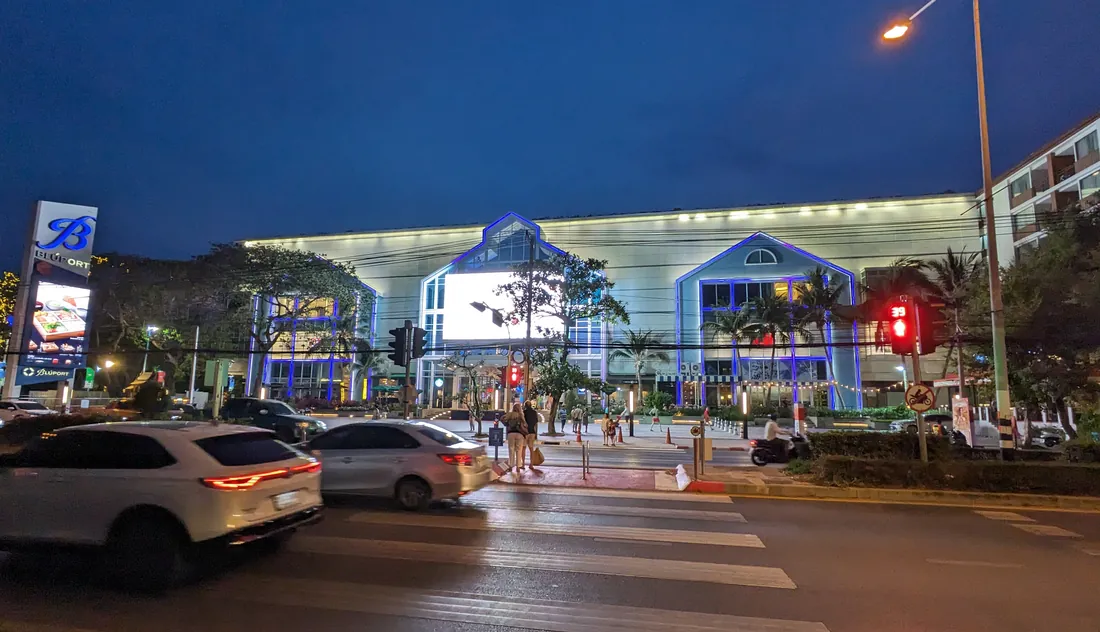
Hua Hin’s immigration service point is inside BluPort, the shopping centre on Phetkasem Road, operating under Prachuap Khiri Khan Immigration. It handles 90-day reports and extensions. Local reporting indicates it moved from the basement to the third floor. We are not going to publish opening hours or queue times here, because both change and stale numbers are worse than none — check on the day.
Which office you deal with follows where you live, so the choice of neighbourhood has a small administrative tail to it.
What to do next
Three things, in order.
Ask your landlord for the TM30 receipt before you sign anything, and confirm they know how to file. A landlord who has never heard of it is a landlord who will cost you a morning later.
Work out your 90-day due date from your last entry stamp, not from your visa, and put a reminder in your calendar 20 days before it.
Check the rules against the Immigration Bureau’s own pages rather than a forum, because both of these have been amended in the last few years and will be again. A new immigration platform called THIM is scheduled to launch on 1 October 2026, with 90-day reporting listed among its planned functions. It is not live for this purpose yet.
If you would rather someone walked you through the first filing of each, that is part of what we do. No obligation to use us for anything else.
Please check before you act. Thai visa, tax, banking and property rules change,
and different offices and consulates interpret them differently. Everything here is a starting point, not advice.
Confirm your own position with the Thai embassy or consulate you will use, the Immigration Bureau, and where money
or law is involved, a qualified Thai professional. Last reviewed 31 July 2026.
Not sure where to start?
Thirty minutes on a call, no obligation. We will tell you what is realistic for your timeline and what to do first.
Book a free consultationKeep reading
Moving
Bringing a Dog or Cat to Thailand: The Real Timeline
What importing pets to Thailand actually involves: the order of microchip and rabies vaccination, the DLD…

Property
The Nominee Company Crackdown, and What It Means If You "Own" a Hua Hin Villa
Thailand's nominee-company crackdown now reaches Prachuap Khiri Khan. The DBD orders, the 1 August 2026 b…
Visas
Thailand Is Cutting Visa-Free Stays To 30 Days. Here Is Where It Actually Stands.
Thailand has approved cutting visa-free stays from 60 days to 30. As of 3 August 2026 it is not yet law. …