
Visas
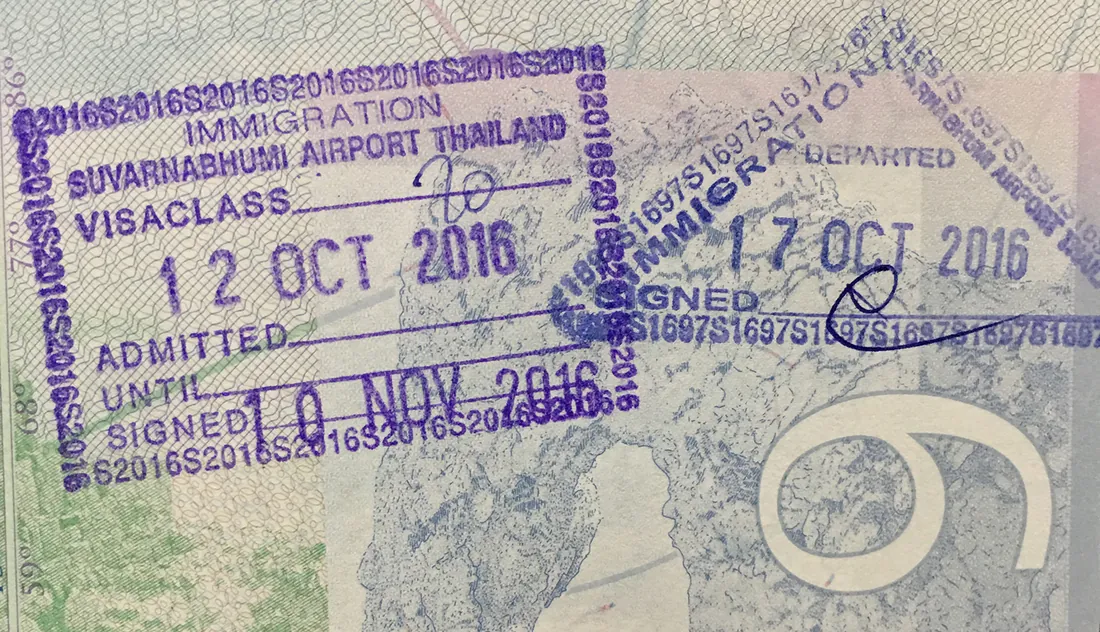
If you have spent the last two winters in Hua Hin on a visa-exempt stamp, flying in around November and out again in January, the ground is moving under you. Thailand’s Cabinet has decided to scrap the 60-day visa exemption and replace it with 30 days for most nationalities. That decision is real. What it is not, yet, is law.
The gap between those two things is the whole story, and it is where most of the panicked forum posts go wrong.
Status as of 12 September 2026: this is now law
It is settled. The rules were published in the Royal Gazette on 31 August 2026 and take effect on 15 September 2026. When we first wrote this in August the change had been approved but not gazetted, and we said so. That caveat is gone. The Tourism Authority of Thailand announced the final framework in September and the mainstream Thai press has reported it consistently since.
What it means in practice: if you arrive on or after 15 September 2026 under the visa exemption, you get 30 days, not 60.
One thing we cannot tell you with certainty. Several outlets report that anyone who entered on or before 14 September keeps the full 60 days already stamped in their passport, which is how Thailand has handled this kind of transition before. We have not found it confirmed by the Immigration Bureau in writing, so we are not going to promise it. If you are in the country now on a 60-day stamp, ask at your local immigration office rather than relying on a news article. Including this one.
What the new framework says
The scheme being replaced dates from July 2024 and gave 60 days visa-free to nationals of 93 countries and territories. The replacement covers 65 countries and territories on a “one country, one entitlement” principle, sorted into three tiers.
- 30 days visa-free for 60 countries and territories, including all 27 EU member states, the United Kingdom, the United States, Canada, Australia and India
- 15 days visa-free for Mauritius and the Seychelles
- Visa on arrival for Azerbaijan, Belarus and Serbia
Separate bilateral agreements sit outside this framework and are unchanged. They give 14, 30 or 90 days depending on the country: China, Laos and Vietnam at 30 days, South Korea, Brazil, Argentina, Chile and Peru at 90. That is how a list of 93 becomes a list of 65 without stranding anybody. Many of the countries dropped from the 60-day scheme still enter under a treaty.
The May and July versions do not match
This matters, because older articles are still near the top of the search results.
The official May position, published by the Ministry of Foreign Affairs after the 19 May Cabinet meeting, was 54 countries and territories at 30 days, three at 15 days, and four on visa on arrival. India was in that visa-on-arrival group. The Maldives was in the 15-day group.
The July version is different. India moves to the 30-day exemption instead of visa on arrival, which reporting attributes to its economic and trade weight. The Maldives moves up to 30 days as well. The 30-day tier grows from 54 to 59, and July reporting specifically names Bulgaria, Croatia, Cyprus and Malta among the 59. The arithmetic does not fully close in the public reporting, and we are not going to pretend that it does. The two announcements were made two months apart, and the second revised the first.
The honest summary is that the July framework supersedes the May one, and that if a country’s treatment mattered to you in May it is worth rechecking now. Neither version is in force yet.
Why Thailand is doing this
The stated reason is not tourism numbers. It is misuse. Thai officials have said the 60-day window was being used to enter the country for activities inconsistent with tourism, meaning unlicensed work and the scam-centre operations that have dominated Thai security reporting for two years. The framing in the Thai press was blunt: the exemption could be used as a route to enter the country to commit illegal acts. The Immigration Bureau’s enforcement campaign reported denying entry to just under 30,000 foreigners in the first five months of 2026.
A retired couple from Yorkshire taking a house near Khao Takiab for the winter is not the target. The rule does not know that.
Who is affected, and who is not
If you hold a non-immigrant visa — retirement, marriage, business, education — nothing here touches you. If you hold a Destination Thailand Visa, an LTR or a Thailand Privilege card, nothing here touches you either. This change is only about arriving with no visa at all.
Existing stamps are not cut retroactively. Both the May and July announcements state that people already in Thailand keep the permitted stay they were granted, and that entries made before the rules take effect run their full course. If you land on a 60-day stamp the day before the new rules bite, the stated position is that you keep the 60 days. We would still not build a trip around landing on the right side of a date nobody has published.
What it does to a Hua Hin winter
The classic pattern is a 60-day stamp plus a 30-day extension at immigration for ฿1,900. Ninety days: fly in early December, leave at the start of March. Long enough for the cool season, the whole of the high season, and a real sense of what living here is like rather than holidaying here.
Under the new framework that becomes 30 days plus a 30-day extension. Sixty days in total. Two months instead of three, and the second month costs you a morning at the Prachuap Khiri Khan immigration office. The Hua Hin branch takes appointments online, which is worth using.
For a three-week look-see trip, this changes nothing. For a six-week trip, nothing. If you have been treating the 60-day stamp as a winter residence permit, it halves your runway and doubles the number of times you sit in front of an immigration officer.
Border runs are not what they were
Two things have closed off the old workaround.
First, visa-exempt entries by land have been capped at two per calendar year since December 2016, and that cap is now enforced rather than nodded at. The rules taking effect on 15 September write the cap into the new framework explicitly, for both the 30-day and the 15-day tiers, and name the exceptions: nationals of Malaysia, Brunei, Indonesia and Singapore are not subject to it, along with any other nationalities the Minister designates. For everyone else it is two land entries a year, in writing this time. Air arrivals carry no written numerical limit, but officers have always had discretion to refuse entry to somebody whose passport reads like a residence history, and they are using it. A separate rumour circulated in early 2026 about a two-entry cap on all arrivals including flights. The Immigration Bureau denied that one. The land cap is the real one.
Second, geography. The Thai-Cambodian land crossings have been shut since late June 2025 and stayed shut through the fighting that July and the ceasefire in December 2025. Reporting on 21 July 2026 had the border still closed with no partial reopening, which removes the cheapest border run from the map. Hua Hin and the rest of central Thailand are unaffected by the conflict itself, which is confined to six eastern border provinces.
If you need more than 30 days
None of these routes is difficult. They do need doing before you fly, not after you land.
- Extension of stay. ฿1,900 at immigration, adds 30 days to a visa-exempt entry. Available now, and expected to continue under the new framework.
- Tourist visa (TR). Applied for at an embassy or consulate before travel. Single-entry gives 60 days with a 30-day extension available. Multiple-entry versions allow repeated stays across six months.
- Destination Thailand Visa (DTV). Five years’ validity, 180 days per entry, extendable once by a further 180 days. Indicatively around ฿500,000 in savings or documented income, plus evidence of employment or freelance work. Documentation scrutiny tightened noticeably during 2026 and refusals happen.
- Retirement routes. For over-fifties, broadly ฿800,000 in a Thai bank or around ฿65,000 a month in verifiable pension income, with insurance requirements that depend on the visa type. Rules differ between the non-immigrant O, the O-A and the O-X, and between consulates.
Those figures are indicative and they change. Requirements vary by consulate, sometimes considerably. Check with the Thai embassy or consulate you would actually apply through, and with the Immigration Bureau for extensions. Nobody can tell you in advance what a particular officer will decide on a particular morning.
The practical point for a snowbird is timing rather than money. If you want three months in Hua Hin this coming winter, the decision about which route to use needs making in September or October, not in the departures hall. Consulate processing runs to weeks, and DTV paperwork takes longer than most people expect.
Where we come in
We track this because we have to. Half the questions we get in October are visa questions dressed up as property questions. If you are working out whether your Hua Hin winter still works at 30 days, or which route fits the length of stay you actually want, talk to us before you book the flights.
Please check before you act. Thai visa, tax, banking and property rules change,
and different offices and consulates interpret them differently. Everything here is a starting point, not advice.
Confirm your own position with the Thai embassy or consulate you will use, the Immigration Bureau, and where money
or law is involved, a qualified Thai professional. Last reviewed 31 July 2026.
Not sure where to start?
Thirty minutes on a call, no obligation. We will tell you what is realistic for your timeline and what to do first.
Book a free consultationKeep reading

Property
Thai Property Law in 2026: What Is Law, and What Is Still a Press Release
The 99-year lease, the 75% condo quota, 30+30+30 renewals. What is actually law in August 2026, what was …
Moving
Moving to Hua Hin: A Twelve-Month Checklist
A month-by-month checklist for moving to Hua Hin: visas, shipping, pets, schools, banking and the first n…
Visas
The Thailand Retirement Visa, Explained for Hua Hin
Who qualifies, how the O-A, O-X and in-country Non-O routes differ, the ฿800,000 rule, insurance, 90-day …