
Living here
You can drive here for a while on paperwork from home. But the reason to get a Thai licence is not really the licence. It is the insurance.
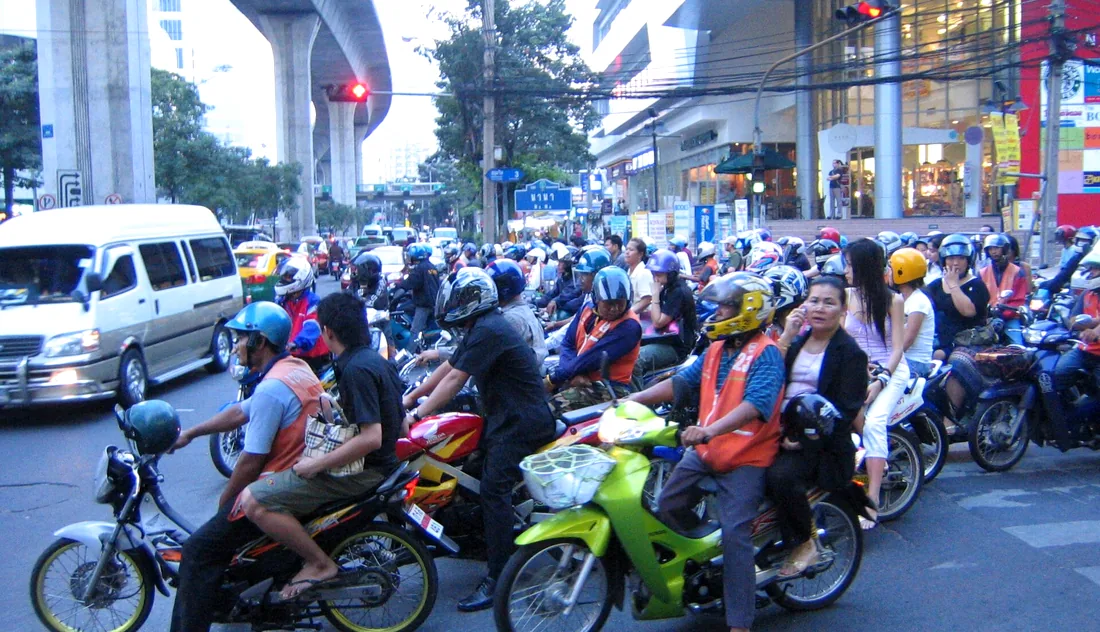
Thailand records around 25.4 road deaths per 100,000 people a year, against 2.4 in the United Kingdom, 3.3 in Germany and 14.2 in the United States. That is roughly ten times the UK rate. About 18,000 people die on Thai roads annually, and 83.8 per cent of them are on motorcycles. This is not a statistic to skim. It is the single largest risk you take on by moving here, larger than anything to do with visas or money.
If you are going to drive, be properly licensed and properly insured. This guide is about how.
Before you have a Thai licence
Thailand is party to both road traffic conventions — the 1949 Geneva Convention since 1962, and the 1968 Vienna Convention since 2020, in force from May 2021. That means both styles of International Driving Permit are recognised.
Which one you need depends on where you are from. British drivers need the 1968 permit; the Foreign Office is explicit that you must carry both the 1968 IDP and your UK licence. Where two countries are party to both conventions, the 1968 one takes precedence. American drivers, whose country is party only to the 1949 convention, use a 1949 permit.
Two things follow. The IDP does not work alone — it is a translation of your home licence, not a substitute, and Thai police will want to see both documents. And an ASEAN licence needs no IDP at all.
You will read that an IDP is valid for ninety days per entry in Thailand. We looked for the legal basis for that and could not find one — no statute, no Department of Land Transport page, no Royal Gazette entry. The defensible rule under the conventions is that recognition of a foreign permit lasts until the host country becomes your normal place of residence. If you have moved here, that has already happened. Treat the ninety-day figure as folklore, and get a Thai licence because you live here, not because a countdown expired.
The penalties for getting this wrong are modest. Driving having never held a licence is up to one month’s imprisonment and a fine of up to ฿1,000. An expired or suspended licence is up to ฿2,000. Failing to produce a licence is up to ฿1,000.
The part that actually costs money: insurance
Compulsory insurance, Por Ror Bor, pays victims regardless of fault — up to ฿30,000 medical and ฿35,000 for death or disability without proof of fault, rising to ฿80,000 medical and ฿500,000 for death once fault is established.
Your voluntary policy is a different matter. The standard approved wording excludes own-damage cover where the driver “has never obtained a driving license”, is disqualified from driving, or uses a motorcycle licence to drive a car. Note what is and is not in that list. Never having held a licence is excluded. Merely holding an expired one is not named.
Your travel or expat medical policy is the third layer, and the one that hurts. The Foreign Office warns that insurers expect you to hold the correct licence for the vehicle you are driving, and that driving without it can invalidate your cover. A serious motorbike accident in Thailand runs from around ฿200,000 into the millions. Being uninsured for that because you were riding a scooter on a car licence is a genuinely life-changing mistake.
Which brings us to the point most people get wrong.
A car licence does not cover a scooter
Thai car and motorcycle licences are entirely separate. There is no engine-size exemption. Not for a 125cc scooter, not for a 50cc moped — Thailand’s declaration under the Vienna Convention explicitly treats mopeds as motorcycles.
If you intend to ride anything, sit the motorcycle test as well. It costs ฿105 for the first two-year licence. It is the cheapest insurance decision available to you.
Two related points. Rental motorcycles are often unregistered and cannot legally be used on a public road, which the Foreign Office flags directly. And since 1 June 2025, both rider and passenger must wear a helmet, with fines up to ฿2,000 — quadrupled from ฿500, and doubled again where a helmetless rider carries a helmetless passenger. Enforcement is heavier in tourist areas than in rural provinces, but the law does not vary.
What the DLT asks for
You need:
Your passport, with the current visa and entry stamp, plus certified copies.
Proof of address. A Certificate of Residence from Immigration, or an embassy letter, or a work permit, or a yellow house book. There is a discrepancy worth knowing: the DLT’s own citizen’s manual says the document may be up to a year old, while in practice offices ask for one issued within thirty days. Assume thirty days.
A medical certificate, on the Medical Council of Thailand’s standard driving-licence form, which has been mandatory since February 2021. It is valid one month from the date of examination — that is printed on the form itself. You declare chronic conditions, past surgery and any seizure history; the doctor certifies no physical or mental impairment preventing driving, no addiction, and the absence of several named conditions. Expect ฿100–300 at a clinic near the DLT office, or ฿600 and up at a hospital.
Your home driving licence, with a certified Thai or English translation if it is in neither language, and your IDP if you have one.
Passport photographs and the DLT’s own forms.
On the Certificate of Residence: you cannot get one without a filed TM.30. If your landlord has not filed it, immigration has no record of your address and the whole chain stops there. Our guide to TM30 and the 90-day report covers how to get that fixed. In Hua Hin the certificate is reported as free on a two-to-three-day turnaround, or ฿500 for same-day service — one source only, so budget for the ฿500 and be pleased if it is free. An embassy letter avoids immigration entirely and is worth considering if your TM.30 situation is messy.
The tests
Road safety training. Five hours for a new applicant, done at the DLT or an approved driving school. If you are converting a valid foreign licence it drops to a one-hour video through the DLT e-learning app with five basic questions at the end. Renewals are one hour online, producing a QR code you show at the office.
Physical tests, about twenty minutes, at four stations: colour blindness using traffic-light colours rather than the dot plates you may be expecting, depth perception with sliding bars, brake reaction time, and peripheral vision.
The written theory test. Fifty multiple-choice questions on a computer, and you need forty-five right — ninety per cent. That pass mark surprises people. It is available in Thai and English; the English translations are occasionally clumsy. Sit a practice test before you go. If you fail, a retake is generally available, often the same day.
The practical test. This is where the current position is genuinely unsettled, and we would rather say so than guess.
Historically, holding a valid foreign licence or IDP exempted you from both the written and the practical test. A draft Department of Land Transport announcement went to public consultation in June 2025 proposing that foreign licences and IDPs would no longer serve as evidence for a Thai licence, and that all foreign applicants must sit the written test. We could not confirm that this draft has been enacted or gazetted — the DLT’s own legal register was unreachable throughout our research.
What the 2025 and 2026 guides consistently report is this: the practical test is normally waived if you hold a valid foreign licence or IDP; the written test increasingly is not. Offices differ. Ring your DLT office before you go and ask which tests you will be sitting, because the answer determines whether you need an afternoon or a day.
Licences, validity and fees
You get a two-year temporary licence first. After holding it, you convert to a five-year private licence.
| Fee | |
|---|---|
| First car licence, two years | ฿205 |
| First motorcycle licence, two years | ฿105 |
| Car licence, five years | ฿505 |
| Motorcycle licence, five years | ฿255 |
| Thai-issued IDP | ฿505 |
All in, including the medical certificate and the residence certificate, a first motorbike licence comes in under ฿1,000.
Minimum ages are eighteen for cars and fifteen for motorcycles. A separate licence for machines over 400cc was announced back in 2020 and, as of mid-2026, has still not been implemented.
Renewal, and what happens if you let it lapse
Converting the two-year to the five-year needs no written or practical test — just the one-hour e-learning and the physical tests, plus a fresh medical certificate and current proof of address.
If your licence expires, there is a ladder:
Under one year late, straight renewal with online training only. One to three years late, you retake the written test. Over three years late, you retake the written and the practical. Do not let it drift.
One local quirk worth planning around: some offices, where an applicant has less than a year left on their visa, issue another two-year licence instead of the full five. Renew when your visa is freshly extended, not when it is nearly up.
Thailand has also run a twelve-point demerit system since January 2023. Everyone starts with twelve points. Speeding, no helmet, phone use and no seatbelt cost one point each; running a red light costs two; hit and run three; drink-driving, racing and reckless driving four. At zero you are suspended for ninety days, and driving during that suspension risks three months’ imprisonment and a ฿10,000 fine. Whether this attaches to foreign licence and IDP holders is not addressed by any source we could find.
Online renewal launched in 2026 for drivers under fifty-five whose licence expired less than a year ago, with the card posted out. The published requirements include a Thai national ID card or the ThaID app, and no source we found addresses whether a foreigner without a Thai ID or pink card can use it. Assume you are going in person.
Where to go if you live in Hua Hin
There is no DLT office in Hua Hin district. This catches people out.
Hua Hin is served by the Pranburi branch of the Prachuap Khiri Khan Provincial Transport Office, at 61 Moo 3, Petchkasem Road, Khao Noi, Pranburi, on 032-621343 or 032-621443, reportedly open Monday to Friday. It serves Pranburi, Hua Hin and Sam Roi Yot. The provincial head office is in Mueang Prachuap Khiri Khan, and there is a third branch at Bang Saphan.
Two honest caveats. Those Pranburi details come from a vehicle industry directory rather than from the DLT itself, whose sites we could not reach — ring before you drive down. And you will find a well-ranked page online listing a “Hua Hin DLT office” with an address and phone number on Petchkasem Road. No such branch appears in any listing of Prachuap Khiri Khan transport offices, and the same site is the sole source for several other claims we could not verify. We would not rely on it.
Some Hua Hin residents use Cha-Am in Phetchaburi province instead, which has historically accepted non-residents. Walk-ins have been permitted nationwide since January 2023, but pre-booked appointments are served first, and there is a recent report of appointments being effectively mandatory at Pranburi with months of waiting. Book through the DLT Smart Queue app if you can.
Rules change, and this set is changing right now
The written-test exemption, the online renewal route and the status of the June 2025 draft announcement are all genuinely unresolved as we write. Fees, forms and office practice vary between provinces and between officers.
Confirm with the Pranburi office before you go. Do not rely on any web page for this, including ours.
What to do next
Sort the TM.30 first, because everything downstream depends on it. Get the medical certificate last, because it dies after a month.
Sit the motorcycle test even if you think you will never ride one. And if you are still weighing up whether you need a car at all in Hua Hin, our guide to where to live covers which neighbourhoods work without one, because that decision changes the answer entirely.
If you want us to check your document set before you make the trip to Pranburi, send us what you have. It is a short conversation and it saves a wasted day.
Please check before you act. Thai visa, tax, banking and property rules change,
and different offices and consulates interpret them differently. Everything here is a starting point, not advice.
Confirm your own position with the Thai embassy or consulate you will use, the Immigration Bureau, and where money
or law is involved, a qualified Thai professional. Last reviewed 31 July 2026.
Not sure where to start?
Thirty minutes on a call, no obligation. We will tell you what is realistic for your timeline and what to do first.
Book a free consultationKeep reading
Visas
TM30 and the 90 Day Report Thailand: What You Must File
TM30 Thailand and the 90 day report Thailand explained: who files, the deadlines, the fines, the official…
Moving
Bringing a Dog or Cat to Thailand: The Real Timeline
What importing pets to Thailand actually involves: the order of microchip and rabies vaccination, the DLD…

Property
The Nominee Company Crackdown, and What It Means If You "Own" a Hua Hin Villa
Thailand's nominee-company crackdown now reaches Prachuap Khiri Khan. The DBD orders, the 1 August 2026 b…