
Visas
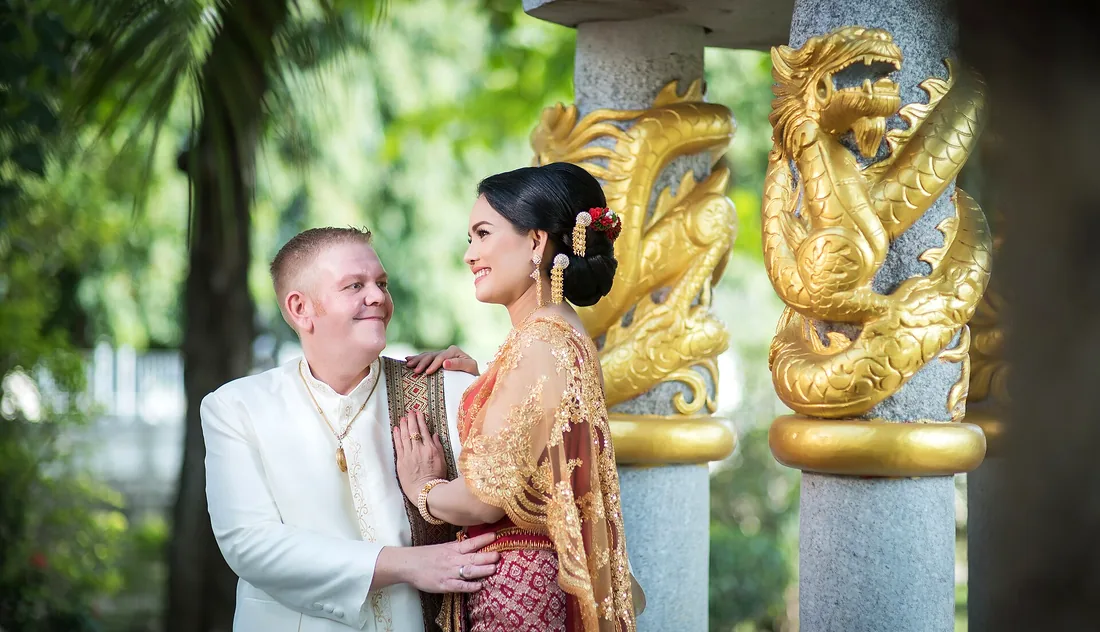
If you are married to a Thai national and over fifty, you can qualify for two different extensions of stay. Most people pick the marriage route because the money is half. That is a reasonable choice and it is often the wrong one, for reasons that have nothing to do with money.
This guide sets out what the marriage route actually requires, and then makes the comparison properly.
The governing rule
Extensions of stay run on Police Order 327/2557. Clause 2.18 is marriage. Clause 2.22 is retirement. Most of what follows comes from the text of that order, and where practice has drifted away from the text, we say so.
The order’s own wording on money is this: an applicant must earn an average of not less than ฿40,000 a month, or must have not less than ฿400,000 in a bank account in Thailand for the past two months.
Two things follow, and both matter.
The seasoning period is two months, and that is confirmed in the order itself — not the three months required for retirement. This is one of the few figures in Thai immigration where the commonly repeated number and the legal text actually agree.
There is no combination option. The word in clause 2.18 is “or”. Retirement’s clause 2.22 has an express third limb letting you add income and savings together to reach ฿800,000. Marriage does not. You meet the deposit or you meet the income; you cannot make up the difference.
The account must be in your name alone. That is administrative practice rather than anything the order says, but it is applied consistently.
The Hua Hin detail that changes the maths
Here is something specific to where you are moving, and we have not seen it flagged anywhere in English.
Bangkok Bank in Hua Hin freezes the ฿400,000 for four months around the annual marriage renewal, according to an immigration briefing from November 2025. Immigration only requires the money to have been present for two months. The bank extends the lock on its own initiative, reportedly to make life harder for people gaming the requirement.
Funds above ฿400,000 stay accessible — only the threshold amount is locked.
This matters because one of the marriage route’s headline advantages is that, unlike retirement, the order imposes no post-approval holding requirement. Retirement makes you keep ฿800,000 for three months after approval and never drop below ฿400,000 thereafter. Marriage, on paper, does not. In Hua Hin, a bank practice puts a good deal of that advantage back.
Ask your branch what they do before you assume your money is liquid.
Getting married first
Many people arrive at this needing to do the wedding as well. The order is strictly sequential and one step has a clock on it.
First, an affirmation of freedom to marry from your own embassy. The US embassy charges USD 50 per notarial seal. The UK figure has been £50 and later £75 in archived guidance, and the live page no longer publishes a Thailand fee table — so check. Germany is different in kind: the Bangkok embassy does not issue the core document at all. You need an Ehefähigkeitszeugnis from your German Standesamt, no more than six months old, and the embassy then issues a consular certificate for €85.68, taking a minimum of fifteen working days.
Second, certified translation into Thai, ฿350 to ฿500 a page.
Third, legalisation at the Ministry of Foreign Affairs. The government fee is ฿200 a document, or ฿400 express, plus ฿200 for the translation check. You will see figures of ฿1,500 to ฿4,000 quoted elsewhere; that is an agent bundling their own fee into it. The Chaeng Watthana office is appointment-only with no walk-ins.
Then the clock: once legalised, the affirmation is valid for ninety days. Register within that window or start again.
Fourth, registration at an amphoe, which costs under ฿100 and is the act that actually creates the marriage. Two Thai witnesses with ID cards must be physically present. Minimum age is now eighteen, raised from seventeen.
You will end up with two documents. The Kor Ror 3 is the certificate you frame. The Kor Ror 2 is the registrar’s formal entry in the civil register, and it is the one immigration wants, freshly issued, because it proves the marriage still subsists.
If you married abroad, the marriage is recognised but has to be brought onto the Thai register first, via a Kor Ror 22 record of family status at an amphoe.
On marriage equality: the Amendment to the Civil and Commercial Code Act No. 24 took effect on 23 January 2025. Section 67 of that Act is what does the work for visa purposes — it provides that every law, regulation, announcement or order referring to husbands or wives applies equally to registered spouses. That language captures Police Order 327/2557 and neutralises its old “alien husband, Thai woman” phrasing. Thai missions began implementing same-sex spouse visa pathways from March 2025. A same-sex spouse of a Thai national can use this route.
What immigration asks for
The document list is longer than retirement’s and two parts of it surprise people.
The basics: form TM.7, passport with copies of every relevant page, the Kor Ror 2 and Kor Ror 3, your spouse’s ID card and house registration, a hand-drawn map from the immigration office to your home, your TM30 acknowledgement, and the bank letter dated the day of application or the day before. Prepare two complete sets. Sign every photocopy. Use paperclips, not staples — offices genuinely care.
The photographs. Not passport photographs, though you need those too. Immigration wants evidence of the marriage as a lived fact: you and your spouse together inside your home, showing the bedroom, the living room and the kitchen. Photographs outside showing the house or unit number. A photograph of the moobaan or condominium sign. No source states how many. The requirement exists because clause 2.18 requires the relationship to be de jure and de facto — legally real and actually real.
The witnesses. Nothing in the order requires them, and the official checklists do not list them, but many offices ask anyway — usually one Thai witness, sometimes two. Neighbours, the village headman, condominium staff. They bring their ID card and house registration and say how long they have known you. Practice varies unpredictably between offices and even within the same office between years.
The home visit. Officers commonly come to verify you live together. Most offices do it for the first application only; some do it every year. Reports suggest Bangkok, Chiang Mai and Jomtien generally do not, and provincial offices generally do. It is usually announced by phone rather than a surprise. They photograph you with the officer. Neighbours may be asked to confirm you live there. We could not establish Hua Hin’s practice — assume it happens.
Some offices ask for “petrol money”. There is no official fee for a verification visit.
Process, timing and fees
The initial 90-day Non-Immigrant O comes either from a Thai mission abroad — three to five working days by e-Visa, around USD 25 — or by converting inside Thailand for ฿2,000, which needs at least fifteen days remaining on your current permission and takes about two weeks.
Watch the mission-level variation. The Thai embassy in Pretoria requires bank statements covering the last three months at the visa stage, not two. Read your own mission’s page rather than assuming.
Then apply for the one-year extension in the final thirty days of that 90-day permission. The fee is ฿1,900. You will get a provisional stamp while Bangkok considers it — reports vary between fifteen and thirty days.
Two things you must not forget. A re-entry permit before any trip abroad — ฿1,000 single, ฿3,800 multiple — because leaving without one cancels the extension entirely. And the 90-day report, which can be filed online, with the count resetting every time you re-enter the country. Late filing is ฿2,000.
Steady state, doing it yourself, is ฿1,900 a year plus a re-entry permit. Agents charge ฿10,000 to ฿40,000. If you genuinely meet the requirements, you do not need one.
Work rights: the real advantage
This is where the marriage route decisively beats retirement, and it is widely misunderstood in both directions.
The extension does not give you the right to work. You still need a work permit. Being married to a Thai national exempts you from nothing.
What it does is make you eligible, and it halves the employer-side thresholds. Normally a company must have four Thai employees and ฿2 million in registered capital per foreign worker. For a foreigner married to a Thai national, that drops to two Thai employees and ฿1 million.
There is a structural benefit too. Someone on a business visa loses their right to stay when the job ends. Your right to stay is not tied to your employment — it is tied to your marriage. That is a meaningfully different kind of security.
Retirement forecloses employment entirely. If there is any chance you will work here, that is not a small difference.
Marriage or retirement: the honest comparison
| Marriage | Retirement | |
|---|---|---|
| Deposit | ฿400,000 | ฿800,000 |
| Income alternative | ฿40,000/month | ฿65,000/month |
| Combination allowed | No | Yes |
| Seasoning before | 2 months | 3 months |
| Post-approval hold | None in the order | ฿800k for 3 months, then never below ฿400k |
| Age requirement | None | 50+ |
| Work permit possible | Yes, at halved thresholds | No |
| Home visit | Common | Rare |
| Photographs of your home | Yes | No |
| Witnesses | Sometimes | No |
| Spouse must attend | Often | N/A |
| Survives if the relationship ends | No | Yes |
Marriage wins on two things: half the tied-up capital, and the right to work.
Retirement wins on everything else, and the things it wins on are not trivial. Nobody photographs your bedroom. No officer comes to your house. No neighbour is asked how long they have known you. Your spouse does not take a morning off to sit at the counter with you. And your right to remain in the country does not depend on another person’s continued cooperation, or their continued life.
That last point is the one people underrate. A marriage extension is a relationship-dependent status that gets audited annually for authenticity. Immigration is explicitly directed to test whether the marriage is real in fact and not only in law. Retirement carries no such recurring burden.
If the marriage ends — divorce or bereavement — the basis for your stay ends with it. Sources conflict on whether you must leave immediately or may run to the end of the current extension, and we could find no statutory grace period at all, so we are not going to give you a number. What we will say is this: switching to retirement afterwards means finding double the money and seasoning it for three months, not two. Anyone over fifty on a marriage extension who could foreseeably need to switch should keep the retirement money seasoned in parallel. The two-month marriage seasoning does not satisfy the three-month retirement rule.
Our blunt recommendation for someone over fifty who qualifies for both: if you will never work here, take retirement and treat the extra ฿400,000 as the price of privacy and independence. If you might work, or ฿800,000 is a genuine constraint, take marriage and budget for a home visit and an annual paperwork exercise. Our retirement visa guide covers the other side in full.
Where you go in Hua Hin
Marriage extensions are handled at the main immigration office at 439 Moo 1, Thap Tai, Hua Hin, on 032-520617 or 032-520620, open Monday to Friday 08:30 to 12:00 and 13:00 to 16:30.
Not at the Bluport branch. That one moved to the third floor of Bluport mall in July 2025 and opens 11:00 to 17:00, but it only handles 90-day reports, re-entry permits, 30-day extensions and TM30 filing. Turning up there with a year’s extension paperwork wastes a morning.
Rules change, and this set varies by office
The financial thresholds come from a 2014 police order that is still operative, but office practice around witnesses, photographs and home visits varies between provinces and between years, and none of it is published. Missions abroad add their own conditions. The Hua Hin bank freeze is a commercial practice that could change tomorrow.
Confirm with Thap Tai before you go. Do not rely on any web page, this one included.
What to do next
Get the Kor Ror 2 freshly issued rather than using an old copy. Get the bank letter the same morning. Take two sets of everything.
Before you commit to the marriage route, ask your bank what they do with the ฿400,000 at renewal — in Hua Hin specifically, the answer may not be what the immigration rule implies.
And if you are weighing marriage against retirement, tell us your age, whether you might ever work here, and how tight ฿800,000 would be. That is a twenty-minute conversation that decides the next ten years of your paperwork, and it is worth having before you apply rather than after.
Please check before you act. Thai visa, tax, banking and property rules change,
and different offices and consulates interpret them differently. Everything here is a starting point, not advice.
Confirm your own position with the Thai embassy or consulate you will use, the Immigration Bureau, and where money
or law is involved, a qualified Thai professional. Last reviewed 31 July 2026.
Not sure where to start?
Thirty minutes on a call, no obligation. We will tell you what is realistic for your timeline and what to do first.
Book a free consultationKeep reading
Money
Health Insurance in Thailand: What It Costs, and When It Stops Being Available
What Thai visas actually require, what cover costs by age, the age at which insurers stop saying yes, and…

Money
Getting Money Into Thailand: Transfers, Pensions and the 800,000 Baht Rule
How long the money has to sit in the bank, why the cheapest transfer can be the wrong one, what happens t…
Living here
The Thai Driving Licence: What It Takes, and Why You Want One
Whether your IDP is enough, what the DLT asks for, which tests you sit, what it costs, and where people i…