
Living here
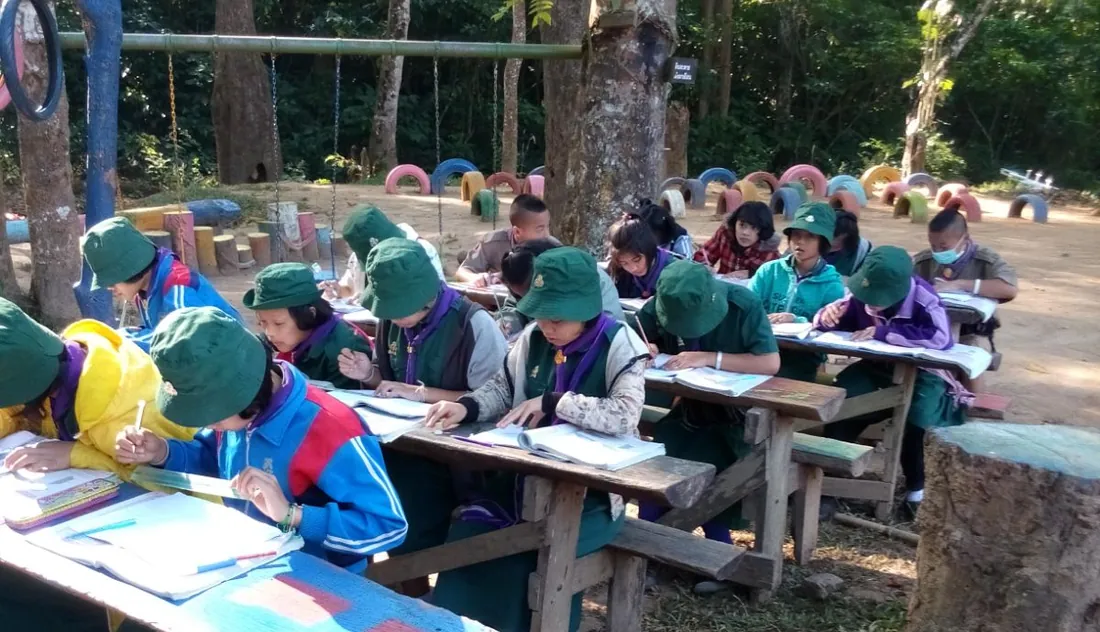
You can change your mind about a house. You can change your mind about a visa. Changing your mind about a school halfway through a year, with a child who has just worked out who her friends are, costs more than money.
Hua Hin’s choice is small. That is the first thing to understand, and most of what follows comes out of it. Here is what actually exists, roughly what it costs, and the parts that catch people out.
What actually exists
There are three tiers, and they are separated by a lot of money.
At the top is Hua Hin International School, out at Hin Lek Fai, west of town past the bypass. It opened in 2015 and now has somewhere over 400 students from more than 30 nationalities. Teaching is in English. It runs a British curriculum through to Cambridge IGCSE in Years 10 and 11, then the IB Diploma Programme in Years 12 and 13, and it is accredited by Cambridge, the IB organisation and CIS. It is the only school in the area that will take a child at three and hand them back at eighteen with a qualification a foreign university recognises without a covering letter.
Published fees for 2025/26 ran from around ฿580,000 a year in kindergarten and lower primary up to around ฿712,000 in the final two years, with a one-off enrolment fee of ฿80,000 and a ฿4,000 application fee on top. Treat all of that as indicative. Fees are reset annually and the school’s own current schedule is the only figure that counts.
The middle tier is bilingual. Beaconhouse Yamsaard School Hua Hin teaches a British and Thai curriculum with both English and Thai as languages of instruction, from three to eighteen. Indicative fees have run from roughly ฿144,000 a year in kindergarten to roughly ฿189,000 in the upper years, plus a ฿10,000 registration fee. Somtawin Witead Suksa, also out at Hin Lek Fai, runs an English-medium programme at an indicative ฿100,000 to ฿120,000 a year. Both are a different proposition from a full international school, not a discounted version of one.
There are also two smaller schools that stop before secondary. The BECC — the British Educational Children’s Centre, on the Nong Kae side of town — teaches an adapted English curriculum to roughly two to thirteen and does not publish fees. Halio, ages three to twelve, is project-led and deliberately unconventional, with indicative fees around ฿150,000 to ฿200,000. Both can be very good for the early years. Neither solves secondary, so if you choose one, choose it knowing you will be doing this exercise again in a few years.
The third tier is Thai private schools. Hua Hin Vitthayalai, the Salesian school on Phetkasem Road, is the best-known, and it runs an English Programme stream alongside its Thai one. Fees here are an order of magnitude lower — commonly tens of thousands of baht a year rather than hundreds. The teaching, the calendar and the culture are Thai. This works well for young children and for families who genuinely intend to stay. It is hard on a twelve-year-old who arrives with no Thai.
Cha-am has nothing at this scale. Families living there drive into Hua Hin, which is 25 to 40 minutes depending on the hour.
The curriculum question, honestly
British, IB or American matters enormously in one situation and much less in the other.
If there is any chance you move again, or that a child goes back into a home-country system, curriculum is the thing to get right. IGCSE at sixteen slots back into the English system cleanly. The IB Diploma is understood everywhere and taken seriously by universities in Britain, Europe, North America and Australia. An American high school transcript is straightforward for US colleges and needs explaining elsewhere.
If you are staying until your child leaves school, the curriculum label matters far less than the teaching, the class sizes and whether your child is happy on a Wednesday afternoon. And in Hua Hin the question is partly theoretical anyway: one school offers the IB Diploma. You are not choosing between three systems. You are choosing between one international school, a bilingual school, and a Thai one — and then deciding whether that is enough.
Admissions: start earlier than feels sensible
Admissions here are rolling rather than deadline-driven. Rolling does not mean available. A small school runs one or perhaps two classes per year group, so a single family arriving ahead of you can close a year. Reception, Year 7 and the IGCSE and Diploma entry points fill first and hardest.
Enquire nine to twelve months before you want a place. Apply the moment you are sure. Application review can take a couple of weeks, and the place is not yours until the enrolment fee is paid — which means you may be committing five figures in baht before you have signed a lease. Plan the order of those two decisions deliberately.
Placement is not automatic by age. Schools look at prior schooling and readiness as well as birth date, and a child may be offered a year below the one you expected. Ask about that early rather than discovering it in an offer letter.
Assessment and English support
Teaching is in English, and schools assess whether they can support a child who does not arrive with it. That assessment is not a pass or fail so much as a capacity question — how much support this child needs, and whether the school has it spare.
Ask directly, and get the answer in writing: is there a dedicated EAL teacher or does the class teacher absorb it, how many hours a week does a child actually get, is it charged separately, and is there a cap on the proportion of a class that needs it. Small schools vary a lot here, and the honest ones will tell you when a child is better served elsewhere for a year.
What the fee does not include
The tuition line is the start of it. Budget separately for:
- Application and registration fees, and a one-off enrolment fee or deposit that can run into the tens of thousands of baht
- Uniform and PE kit, the school bus, day trips and residentials, lunch, devices, after-school clubs
- Exam entry fees for IGCSE and the IB Diploma, which land in the years your fees are already highest
None of these is unreasonable. All of them are easier to plan for in March than to discover in September.
The school run decides which side of town you live on
This is the practical decision most families get backwards. They pick a house, then work out the drive.
Hua Hin International School is inland and west, at Hin Lek Fai. If you live south towards Khao Takiab or out at Pranburi, you are on the bypass twice a day, in the same traffic as everyone else, in the rain for part of the year. If you live north towards Cha-am, it is a different road and a different problem. The school bus exists and works, but it adds real time at both ends of a small child’s day.
Drive the route at half past seven on a Tuesday morning before you sign anything. Not at eleven on a Saturday. The two journeys are not the same journey, and the difference between them is roughly the difference between a manageable school run and an unpleasant one, repeated 190 times a year.
Term dates, and the relatives who want to visit
International schools here run a broadly Western calendar: an academic year from August to June, about five weeks off in July and August, two weeks at Christmas, and a spring break of a fortnight or so. Thai schools run their own year — mid-May to early March, with the long break falling from late March to mid-May, which is when it is hottest.
Two consequences. Your long holiday is July and August, which is high season for airfares out of Thailand and not the loveliest weather here. And if you end up with one child at an international school and another at a Thai one, the two calendars will not line up, which makes a family trip genuinely difficult to arrange. Get the published term dates for the coming year from each school before you promise anyone anything.
The trade-offs of a small-town school
Be clear-eyed about this. A small international school gives your child attention, a teacher who knows their name, and no anonymity. It also gives them a narrow world.
Subject choice at IGCSE and Diploma level is limited by arithmetic. A school of this size cannot timetable five sciences, three modern languages and a full arts programme, and some combinations simply clash. If your fourteen-year-old is set on further maths and Mandarin, ask specifically whether that pairing runs.
Sports fixtures mean travelling, often to Bangkok, often on a Saturday. There is no local league to speak of. And the social point is the one parents underestimate: your child’s class is your social circle too. That is warm and easy when it works. When it does not — a fallen-out friendship, a difficult family, a child who does not fit the year group — there is no other class to move to and no other school to move to. Ask current parents about that, not the admissions office.
Teacher turnover is worth asking about as well. Small schools in small towns lose staff, and a departing head of secondary matters more in a school of 400 than in one of 2,000.
Bangkok, and the families who split
Bangkok has more than 100 international schools, across every curriculum and price point from around ฿100,000 to well over ฿1.5 million a year. Hua Hin has one at the top end. That is the trade you are making, and no amount of framing changes it.
Some families make it work by splitting the week — one parent and the children in Bangkok during term, everyone in Hua Hin at weekends. Others do primary here and move for secondary, which is a clean break at a natural point. Both are common enough that you should think about them now rather than treat them as a failure later. Deciding in advance that you would move for Year 10 is a very different experience from deciding it in a hurry in Year 9.
Fees, term dates, curricula and staffing all change from year to year. Everything above is a starting point for a conversation with the schools, not a substitute for one. Confirm the current numbers directly with each school before you make a decision on the strength of them.
Where we come in
We drive the school run with you at the hour you would actually be driving it, and we put you in front of parents who are already doing it, not just the admissions team. Then we look at housing with the school already fixed, rather than the other way round.
Please check before you act. Thai visa, tax, banking and property rules change,
and different offices and consulates interpret them differently. Everything here is a starting point, not advice.
Confirm your own position with the Thai embassy or consulate you will use, the Immigration Bureau, and where money
or law is involved, a qualified Thai professional. Last reviewed 31 July 2026.
Not sure where to start?
Thirty minutes on a call, no obligation. We will tell you what is realistic for your timeline and what to do first.
Book a free consultationKeep reading

Housing
Renting a House or Condo in Hua Hin: What It Costs and What to Check
Real long-term rents, the electricity clause that costs more than your deposit, what the lease has to say…

Living here
Vet Care in Hua Hin: What It Costs, and What Will Actually Make Your Animal Ill
Realistic prices for routine and emergency care, the diseases your vet at home never had to think about, …
Visas
The Thai Marriage Visa: What It Costs You, and What It Costs You in Privacy
The ฿400,000 rule and the Hua Hin bank practice nobody warns you about, what immigration photographs, the…