
Living here
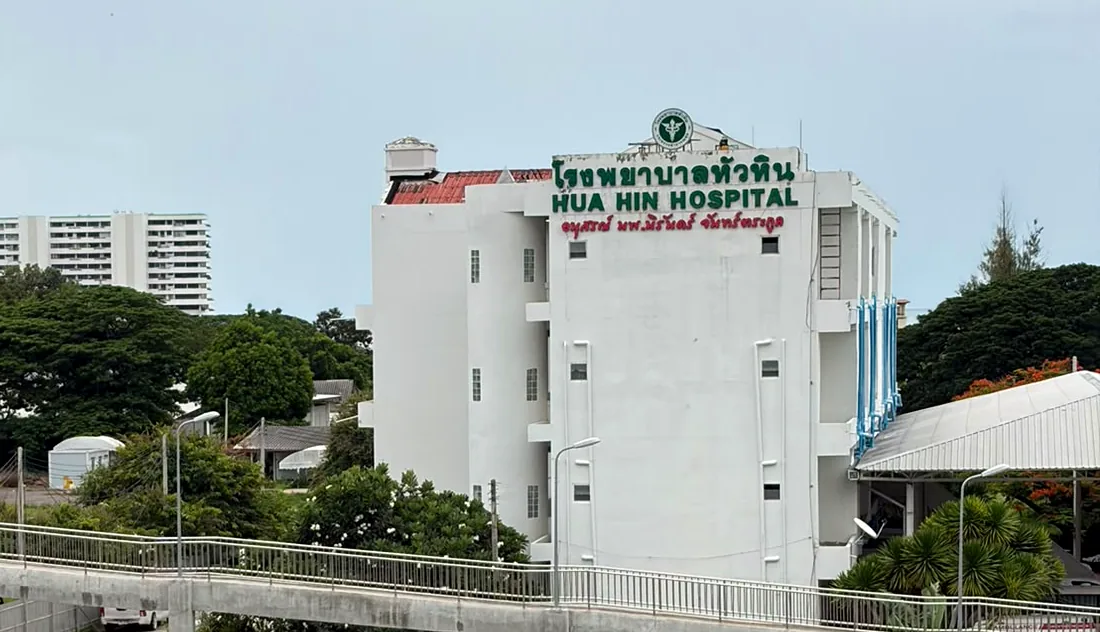
Hua Hin is not short of somewhere to go when you are ill. It is short of somewhere to go when you are seriously ill. Those are two different problems, and people moving here tend to check the first and assume the second follows. It does not. What follows is how the town’s healthcare actually works, roughly what it costs, and the gap you should plan around.
Nothing here is medical advice, and none of the figures are quotes. Prices move, packages get renamed, and insurers reprice every year. Treat everything below as indicative and confirm it with the hospital or the insurer before you rely on it.
The three tiers people actually use
The first tier is private and international-facing. Bangkok Hospital Hua Hin sits at 888 Petchkasem Road, opened in 2011, and is part of the BDMS group. It is not large — around 64 beds, of which roughly a dozen are intensive care. English is spoken throughout, you can usually book online and be seen the same day or the next, and most international insurers have direct billing arrangements with it. It is the default for foreigners here, and it is priced accordingly.
San Paulo Hua Hin Hospital, at 222 Petchkasem Road, has been open since 1997 and runs a broader spread of clinics than its size suggests — internal medicine, surgery, orthopaedics, cardiology, obstetrics, dialysis, an ICU. There are English, German and Filipino speakers on staff. For routine work it is noticeably cheaper than Bangkok Hospital, sometimes by a factor of three for the same test. Plenty of long-term residents use it as their first stop and keep Bangkok Hospital for the things insurance is paying for.
The second tier is Hua Hin Hospital, the government hospital at 302 Petchkasem Road. It has been there since 1938 and it is where most Thai residents of this town go. It is dramatically cheaper. The trade is queueing — arriving at six in the morning to be seen that day is normal — and thinner English outside the clinic set up for foreign patients. For a straightforward problem, when you have the whole morning and ideally a Thai speaker with you, it works.
The third tier is clinics and pharmacies. A private GP or specialist clinic for a rash, a chest infection, stitches, a repeat prescription. And a pharmacy for anything smaller than that, which in Thailand covers more ground than you are used to.
What it costs, roughly
These are indicative ranges, not a price list:
- A consultation. Government hospital: under ฿700 all in for an outpatient visit. San Paulo: a few hundred to around ฿1,000. Bangkok Hospital Hua Hin: roughly ฿500 to ฿1,500 to see a general practitioner, ฿1,000 to ฿2,500 for a specialist, before anything is done to you.
- A scan. A CT at Bangkok Hospital can land near ฿30,000. An ultrasound with a consultation might be ฿4,000 at San Paulo against three times that at Bangkok Hospital. The government hospital is cheaper again, if you can wait for the slot.
- An overnight stay. A shared government ward starts around ฿2,000 a night. A standard private room at Bangkok Hospital Hua Hin runs around ฿7,000, a suite more, and intensive care around ฿11,000 — bed only, before treatment, drugs or the surgeon.
The pattern is consistent: Bangkok Hospital charges a meaningful premium over San Paulo for the same routine procedure, and both charge a large multiple of the government hospital. What you are buying at the top is speed, English, and an insurer that will pay the bill directly.
The honest limitation
Hua Hin does not have deep specialist cover. Two modest private hospitals and a district government hospital between them handle a great deal — but complex cardiac surgery, serious oncology, neurosurgery beyond the basics, major trauma, anything needing a subspecialist team on a bad night — that goes to Bangkok. Roughly 200 kilometres, two and a half to three hours by road on a good day, longer if the Rama II works are having one of their weeks.
This is the part to think about before you sign a lease, not after. Three questions follow from it. How far are you from Petchkasem Road, in Friday traffic rather than on a map. Whether you are physically transferable — a stabilised patient in an ambulance is one thing, a person who cannot be moved is another. And whether your insurance pays for treatment in Bangkok, or only locally.
Insurance: local versus international
Thai domestic policies are cheaper, often considerably. They are regulated by the Office of Insurance Commission, and since March 2025 a co-payment structure applies to plans under that framework. The limitations that matter are these. They generally lapse the moment you stop living in Thailand, so they are not portable. Direct billing is less common, which means you pay the hospital and claim it back, and the reimbursement can take weeks. Annual ceilings are lower. And pre-existing conditions are usually excluded outright rather than assessed.
International policies cost more and buy you different things: cover that travels with you, direct settlement with the major private hospitals so you are not putting ฿400,000 on a card at admission, higher or unlimited annual limits, treatment in Bangkok or at home rather than only in your province, and guaranteed renewability regardless of what you have claimed.
For someone who intends to be in Thailand permanently, has no complicated history and wants to spend less, a local plan can be a reasonable answer. For someone who moves between countries, expects to be flown or driven to Bangkok, or wants certainty about renewal at 78, it usually is not.
Age, and the door that closes
Premiums do not rise gently. Thailand has one of the steepest rates of medical inflation in the world, and on comparable plans the premium roughly doubles between 65 and 75 without a single claim.
More importantly, the door closes. Thai insurers typically stop accepting new applicants somewhere between 60 and 70, with renewal-only cover running to about 75 or 80. Several international carriers decline new business from the mid-70s. The consequence is blunt: if you arrive at 68 without cover, your options are already narrower than they were at 58, and if you let an existing policy lapse — a missed payment, a change of bank — you reapply as a new applicant and get underwritten again from scratch. Conditions the old policy covered can come back as exclusions on the new one.
Pre-existing conditions, and honest disclosure
Declare everything. The managed blood pressure, the knee, the thing your GP mentioned in 2019. An insurer that knows about a condition will either cover it, price it, or exclude it — and you will know which before you need it. An insurer that finds out at claim stage may void the policy, and you will be arguing about a ฿600,000 bill from a hospital bed. Full disclosure is not the honourable option. It is the self-interested one.
The visa point
If you hold a Non-Immigrant O-A visa, health insurance is mandatory — currently a minimum of USD 100,000 of cover per policy year, evidenced on the insurer’s certificate, and it is checked again when you extend. The O-X has its own separate outpatient and inpatient minimums, and the LTR has another figure again.
An extension of stay based on retirement from a Non-O entry carries no insurance requirement at all. That difference is the single most common source of confusion among retirees here, and it is why two people of the same age in the same condominium block can be under completely different obligations. Requirements change and offices interpret them differently, so check the current position with Thai Immigration and your embassy rather than with a forum.
Pharmacies, dentists, check-ups and ambulances
Thai pharmacies sell a lot without a prescription — common antibiotics, many maintenance medicines, most things you would need a GP appointment for at home. Narcotics and controlled psychotropics are properly restricted. A pharmacist here is a genuine first stop for minor problems. Buy from a standalone pharmacy rather than a hospital one, where the same box can cost two or three times as much.
Dentistry is the one area where Hua Hin is straightforwardly world-class value, which is why people fly in for it. Indicatively: a scale and polish ฿1,200 to ฿1,800, a filling from about ฿1,000 a surface, a root canal ฿9,000 to ฿13,000 depending on the tooth, a porcelain crown from around ฿10,000, an implant from roughly ฿35,000 to ฿55,000 including the crown. Quality varies by clinic rather than by price, so ask what implant system they use and where the lab is.
Annual check-up packages are widely sold and worth doing. Bangkok Hospital Hua Hin’s basic package starts around ฿3,200, with age-banded packages running to ฿21,000 for men over 50 and ฿27,000 for women. San Paulo prices a comparable senior screen around ฿10,600 to ฿15,600. Routine bloods on their own are a few hundred baht.
Ambulances are the thing that surprises people most. The national emergency number is 1669, it is free, and the operators speak only basic English. Response is not what you expect from home, and outside the built-up parts of town it is slower again. BDMS runs its own line on 1724 and the private hospitals dispatch physician-staffed ambulances at around ฿1,500 to ฿5,000 depending on distance. For anything short of a genuine emergency where movement is dangerous, a taxi or a neighbour’s car to the hospital is frequently faster than waiting. Save the hospital’s direct number in your phone now, not later, and know your own address in Thai.
Where we come in
We can tell you how long the drive to Petchkasem Road actually takes from the building you are considering, at the hour you would be making it. We do not sell insurance and we will not recommend a policy — get quotes for your own age and your own medical history, from more than one broker. What we can do is make sure the practicalities are in front of you before you commit to an address.
Please check before you act. Thai visa, tax, banking and property rules change,
and different offices and consulates interpret them differently. Everything here is a starting point, not advice.
Confirm your own position with the Thai embassy or consulate you will use, the Immigration Bureau, and where money
or law is involved, a qualified Thai professional. Last reviewed 31 July 2026.
Not sure where to start?
Thirty minutes on a call, no obligation. We will tell you what is realistic for your timeline and what to do first.
Book a free consultationKeep reading

Living here
International Schools in Hua Hin, and the Other Options for Expat Families
Hua Hin has one British and IB international school, a few bilingual options and Thai private schools. Wh…

Housing
Renting a House or Condo in Hua Hin: What It Costs and What to Check
Real long-term rents, the electricity clause that costs more than your deposit, what the lease has to say…

Living here
Vet Care in Hua Hin: What It Costs, and What Will Actually Make Your Animal Ill
Realistic prices for routine and emergency care, the diseases your vet at home never had to think about, …